Thurgood Marshall Mobile Museum
Narrative-Driven Spatial Exhibit

The Thurgood Marshall Foundation commissioned a mobile museum experience honoring Marshall's legacy as a civil rights attorney, designed to travel to communities across the country. Working within a mobile exhibition footprint, our team developed a courtroom-inspired spatial narrative anchored by landmark civil rights cases. The project is currently in active development.
Role: Spatial Design Lead, Experience Director, Client Liaison
Tools: Experience Frameworks, Spatial Zoning, Narrative Design, Cross-Disciplinary Coordination
Status: Active development — concept phase complete, refinement ongoing
I am the Spatial Design Lead, and I am responsible for the overall narrative framework, spatial zoning strategy, and interpretive vision of the project. I am guiding all major design decisions, leading cross-disciplinary reviews, and serving as the primary client liaison across presentations to the Thurgood Marshall Foundation. While team members are executing drawings and visual assets, I am maintaining authorship over the experience logic, spatial storytelling, and final design direction.


Two initial spatial concepts; the open symmetry of concept one and the courthouse structure of concept two were synthesized into the final direction.
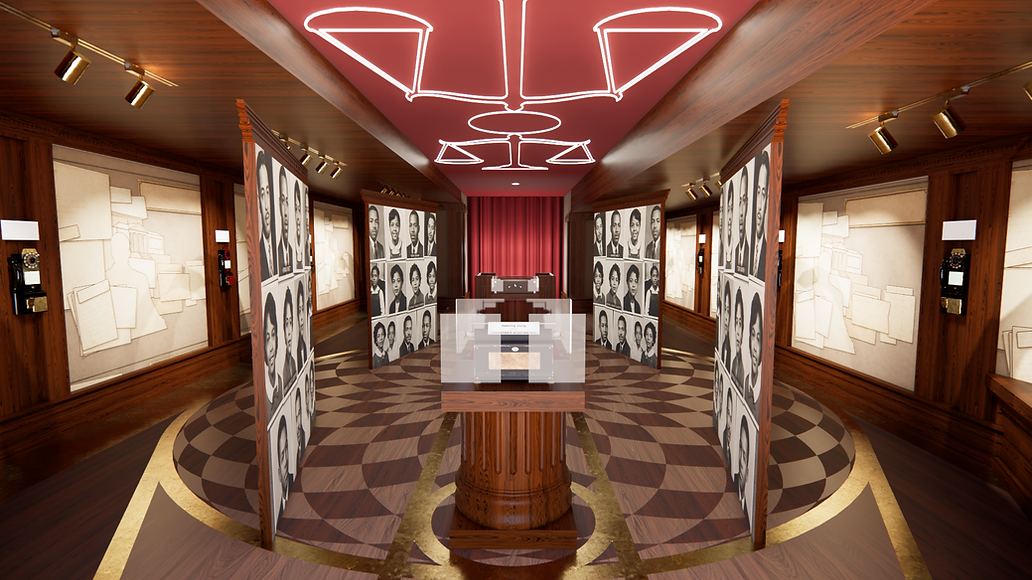
Midterm pitch showing the unified spatial direction before client feedback.

Concept for individual case displays presenting landmark civil rights cases with document walls, telephone audio, and interpretive content.

Refined render following client feedback to brighten the space, add more interactive options, and add seating.


Comparison of render from before and after client feedback.

Floor plan showing the Supreme Court-inspired inlaid floor pattern, zone layout, highlighted artifacts and exhibits, and circulation logic of the refined design.
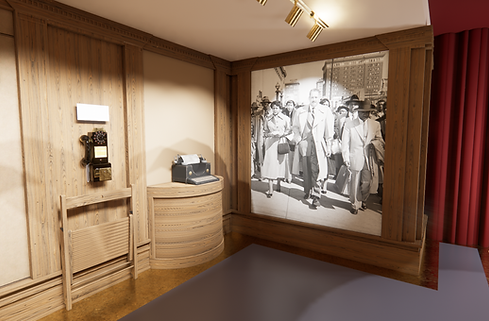

Interactive elements added in response to client feedback. A typewriter and chalkboard to give visitors their own voice in discussing how Thurgood's fight for justice inspires them provide tactile engagement with the cases.
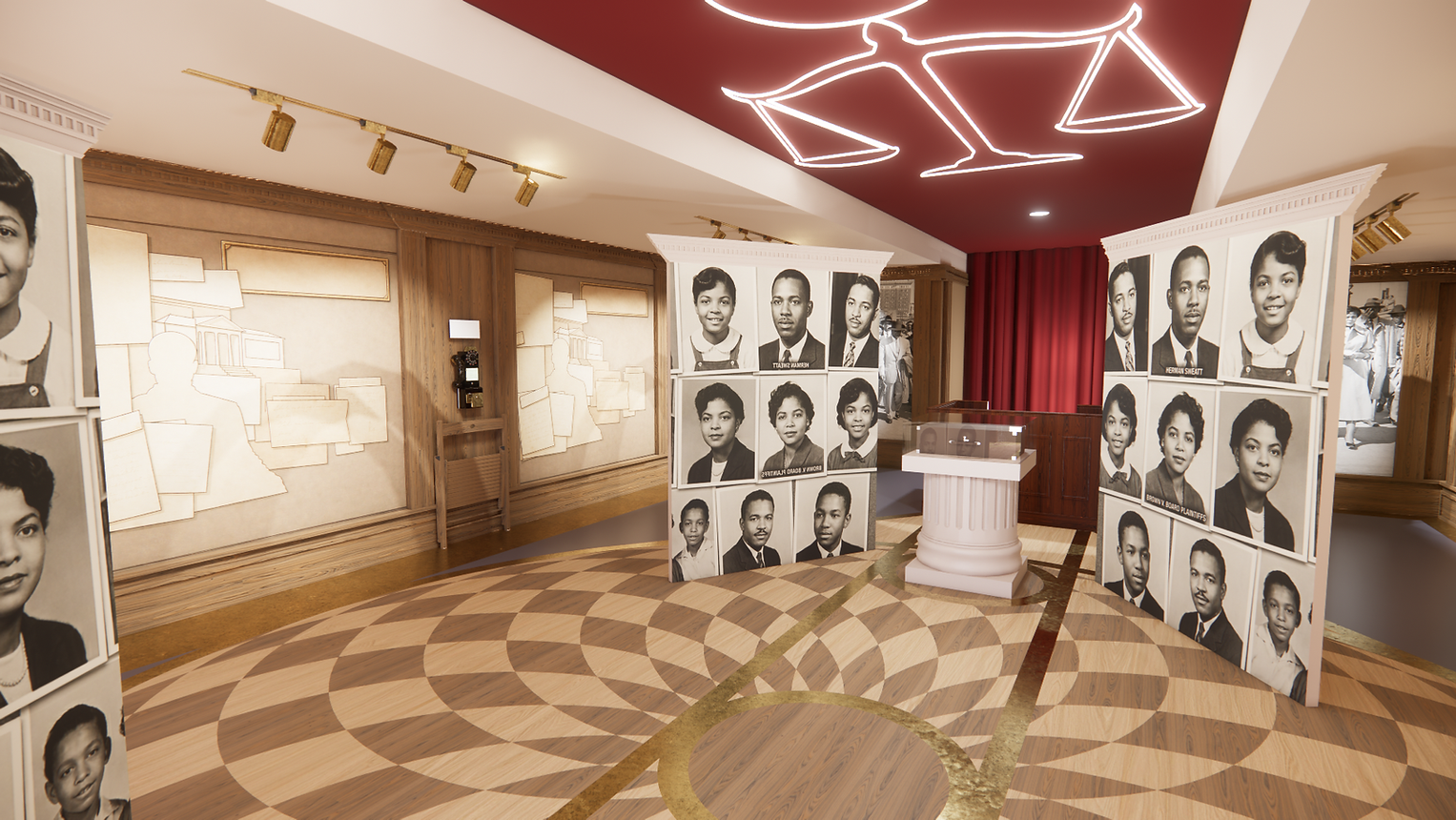
My Design Process The Thurgood Marshall Foundation approached our team to develop a mobile museum experience that could travel to communities across the country, honoring Marshall's legacy as a civil rights attorney while making that legacy feel immediate rather than historical. The central interpretive challenge was avoiding the trap of hero worship. Marshall himself consistently framed his clients as the heroes of the stories he argued, and the design needed to reflect that. The people who took those cases, who put their lives and safety on the line to be plaintiffs, are as central to the experience as Marshall himself. The spatial concept emerged from two initial directions explored in white box form. The first proposed an open, symmetrical layout with a central artifact anchor. The second drew more heavily on courthouse architecture, using columns and case bays to establish an institutional gravity. The final direction synthesized both: the open symmetry and central spine of the first concept combined with the material language and structural references of the second, resulting in a space that feels both intimate and authoritative. The central spine carries Marshall's life story through artifacts arranged chronologically, giving visitors a through-line as they move through the space. The cases along either wall present landmark civil rights cases with document walls, telephone audio interactions, and interpretive content that foregrounds the clients rather than the attorney. Interactive elements including a typewriter, chalkboard, and sticky note stations give visitors tactile ways to engage with the material and leave something of themselves in the space. The first full round of renders was presented to the Thurgood Marshall Foundation as a midterm pitch. Client feedback centered on two things: the space felt too dark, and visitors needed more opportunities for active participation rather than passive observation. Both notes were addressed directly in the refined design, brightening the environment significantly and expanding the interactive element suite. That feedback loop is documented in the image sequence above and reflects the kind of iterative client relationship the project has been from the start. The project is currently in active development. Additional zones and content are in progress, and the design will continue to evolve in response to client input before final documentation is delivered.