The Cursed Bear
Spatial VR Experience

A competitive multiplayer VR game of tag set on a spherical forest world, built with movement mechanics, power-ups, and a live overhead spectator system that turned a private VR match into a watchable public event. Selected for presentation at SIGGRAPH 2024 and featured at the Texas A&M Performance Visualization Series.
Role: Game & Spatial Designer, Systems Developer
Tools: Unity, XR Systems, Spatial Design
Status: Selected for SIGGRAPH 2024 · Featured at Texas A&M Performance Visualization Series
I worked as part of a small development team, leading the visual and spatial design of the spherical forest world and designing the full audio experience. I contributed to multiplayer and power-up systems and helped build the live spectator camera that tracked the active cursed player in real time for public narration and projection.

The spherical forest world: movement, navigation, and environmental set dressing designed for a curved surface.


Environmental set dressing by day and night. Particle effects and power-up visuals designed for readability during live play.

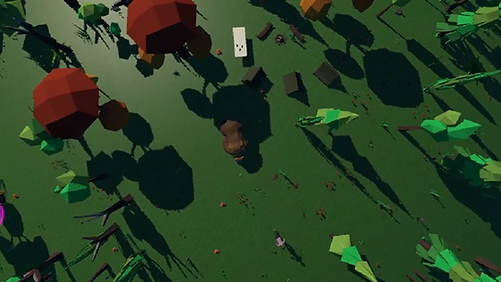
Player view and live spectator camera. The spectator is a dedicated overhead system that tracked the active cursed player in real time, turning a private VR match into a watchable public event.
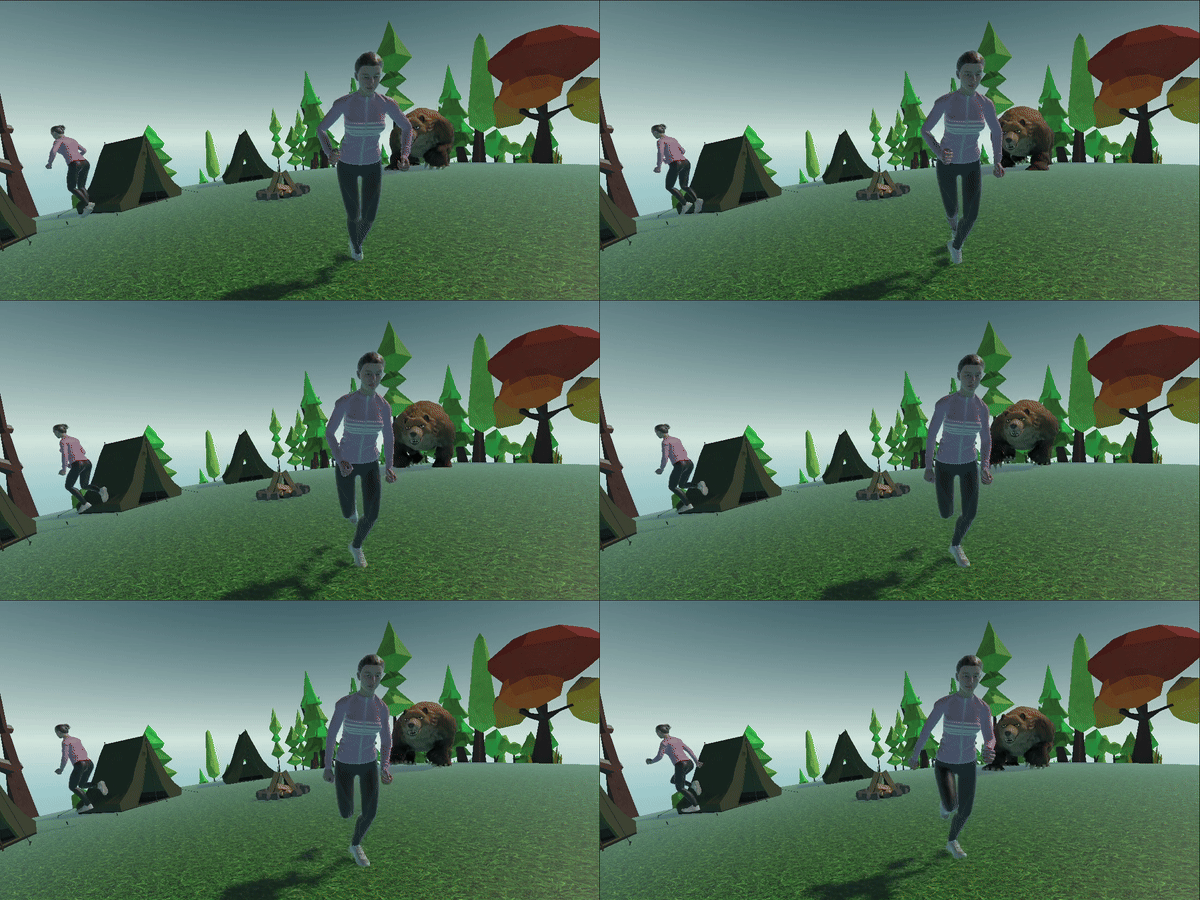
Animation demo for player and bear movement.
My Design Process The Cursed Bear began as a senior-level virtual reality assignment to build a multiplayer game of tag with narrative context, power-ups, and a fully realized environment. The initial concept of setting the game on a spherical world rather than a flat surface was mine, and it became the defining constraint that shaped every subsequent design decision. Movement, navigation, environmental set dressing, and gameplay balance all had to be rethought for a curved surface where the rules of spatial orientation that players take for granted no longer apply. I led the visual and spatial design of the spherical forest world, developing the environmental set dressing, the low-poly aesthetic, and the layout of landmarks and power-up locations to create a space that was readable and fair from any position on the sphere. The world needed to communicate at a glance which direction was toward the bear, where power-ups were located, and how far a player was from safety, all without the flat-plane conventions that most game environments rely on. Lighting, color, and particle effects did much of that navigational work in place of traditional spatial cues. The spectator system was my concept. The core problem was that VR experiences are private by nature, which makes them difficult to present publicly or use as a shared event. By designing a dedicated overhead camera that tracked the active cursed player in real time, the match became something an audience could follow and commentators could narrate. That single design decision transformed the project from a classroom exercise into a live performance artifact, which is what ultimately made it suitable for public presentation. I also designed the full audio experience, covering ambient atmosphere, gameplay feedback, and the sound logic that reinforced the tension of the cursed role transferring between players. While other team members handled significant portions of the technical implementation, the design direction across environment, spectator system, and audio was mine throughout. The project was submitted to SIGGRAPH 2024 by our professor and selected for presentation, and was also featured at the Texas A&M Performance Visualization Series. Both selections reflected the spectator system's ability to turn a private VR experience into something a live audience could watch and engage with.