Savannah Service Museum
Narrative-Driven Spatial Exhibit

Hunter Army Airfield needed a permanent presence in the Savannah-Hilton Head International Airport, legible to everyday travelers in a 500 square foot pre-security space. The completed designs were accepted by HAAF and airport leadership for construction and permanent installation.
Role: Spatial Design Lead, Experience Director, Client Liaison
Tools: Experience Frameworks, Spatial Zoning, Narrative Design, Cross-Disciplinary Coordination
Status: Designs accepted for permanent installation at Savannah-Hilton Head International Airport
I was the Spatial Design Lead, responsible for the overall narrative framework, spatial zoning strategy, and interpretive vision of the project. I guided all major design decisions, led cross-disciplinary reviews, and served as the primary client liaison across four stakeholder presentations. While team members executed drawings and visual assets, I maintained authorship over the experience logic, spatial storytelling, and final design direction.


Early spatial directions explored before converging on a unified concept.

Axonometric cutaway showing zone layout, ceiling structure, and spatial relationships before any material decisions were made.

Narrative perspective with visitor figures, establishing the cockpit as the entry focal point and setting the spatial tone before material development.

Scale model delivered at the checkpoint presentation showing all three zones and the full spatial sequence from entry to community map.


Final elevation of the civilian and military walls, used to inform material render development.


Floor plan and cockpit plan and elevation delivered to HAAF and airport leadership for construction.


Cockpit interior, community map zone, and full museum perspective with complete material specifications.
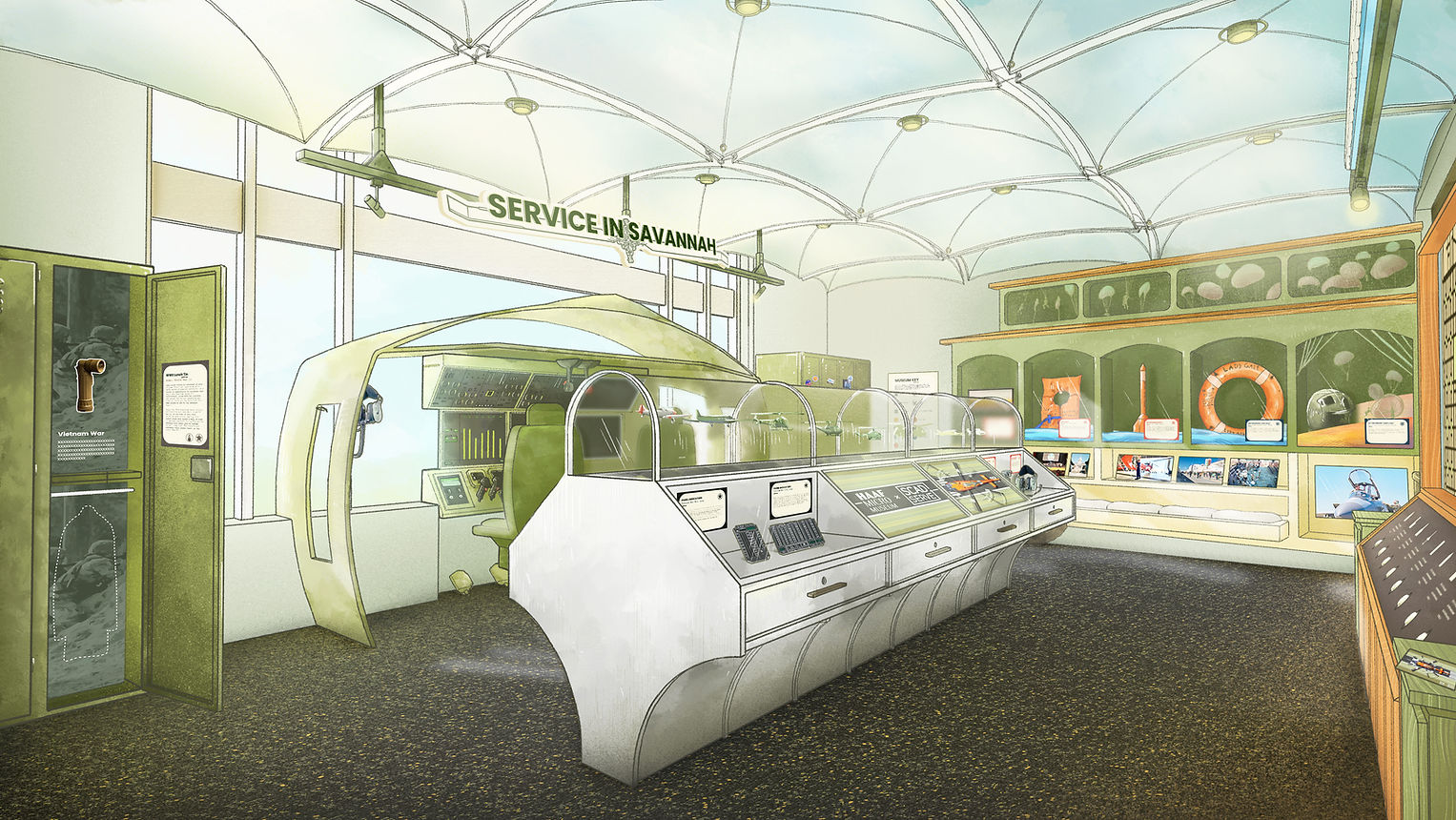
My Design Process The project began with a clear constraint: 500 square feet of pre-security airport space with no captive audience and no guarantee of dwell time. The design challenge wasn't just what to put in the space but how to make it readable to someone passing through in thirty seconds and rewarding for someone who chose to stop. I led the team through three initial concept directions before converging on the zone-based framework that became the final design. The Military Life Zone anchors the entry with a simulated helicopter cockpit and airborne-style lockers displaying uniforms, personal effects, and artifacts, establishing the lived experience of service through scale and physical presence rather than text. The Transition Zone blends military and civilian identity through a Savannah-style trolley displaying military artifacts alongside a military vehicle carrying civilian history, with a dual-use runway case at the center presenting models of planes and helicopters that trace the progression of aviation history in Savannah. The Community Integration Zone closes the experience with a tactile three-dimensional map highlighting Hunter Army Airfield's presence throughout the city, alongside opportunities for visitors to write letters to service members, reinforcing the project's central message: that the military and the community it serves are a connected system, not separate worlds. As Spatial Design Lead and primary client liaison, I guided all major design decisions across four stakeholder presentations with Hunter Army Airfield and airport leadership. While team members executed drawings and visual assets, I maintained authorship over the experience logic and final design direction, redlining work that didn't align with the interpretive vision and pushing the team toward solutions that were both spatially compelling and operationally realistic for an airport environment. The most significant design decision was treating the space as modular from the start. Rather than designing a fixed installation, every component was conceived to allow artifact rotation and content updates without structural changes, giving HAAF a living presence in the terminal rather than a static display that would age out. That decision also made the construction documentation cleaner to deliver since the logic of the system was consistent throughout. The completed designs were accepted by HAAF and Savannah-Hilton Head International Airport leadership for construction and permanent installation.