Society of Storykeepers
MFA Thesis
Physical and Digital Museum Experience

Museums struggle to hold the attention of younger visitors who arrive curious but disengage before they ever connect with the content. Society of Storykeepers is a modular, role-based experience framework that gives every visitor, especially kids, a personal identity and reason to explore. Prototyped as both a physical kiosk system and a fully playable Unity vertical slice, the system delivers genuinely different interpretive content for every role without changing the collection itself.
Role: Experience & Systems Designer, 3D Modeler, Developer
Tools: Rhino, Unity, C#, Narrative Design, Spatial and Physical Prototyping
Status: MFA thesis project, defending May 2026
This is an independent thesis project spanning research, spatial design, 3D modeling, interaction design, and technical development. I designed the narrative framework and system architecture, modeled the physical kiosk and plinth system in Rhino, and built the full Unity experience from scratch in C#, from role assignment through artifact collection to the post-visit personal gallery.

.png)
Empathy mapping from Artifact Adventure, the predecessor project that grounded the role-based system in how younger visitors actually engage with museum spaces.


Early Unity prototype built during Artifact Adventure showing the first working version of role assignment and artifact interaction before the system was fully developed into Storykeepers.

The full role-based system for Storykeepers. Children with different interests explore the same museum with their own interests emphasized through roles.


Each role plinth is color-coded to a visitor role and designed for real museum installation, modeled in Rhino with full material specifications.
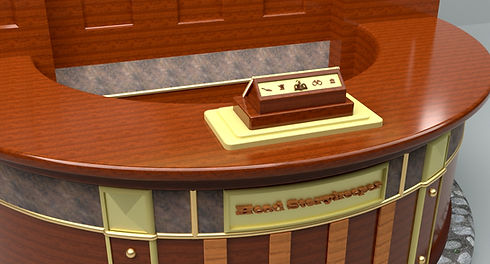

Details of the Head Storykeeper desk, the entry point of the visitor journey and the anchor of the physical installation.
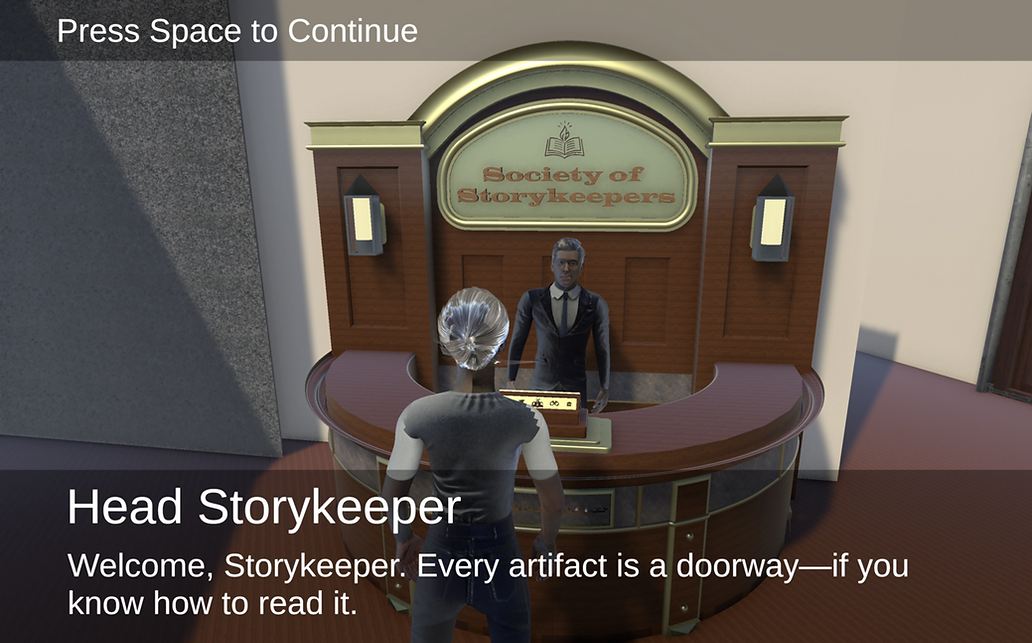

The full system built and playable in Unity. Displayed are an interaction with the docent at the Head Storykeeper desk in the museum lobby and exploring a museum exhibit.


Wright Flyer minigame and return ceremony, two distinct beats of the full interaction pipeline.

Post-visit personal collection showing the visitor's role-filtered record of their experience.
My Design Process The project began with Artifact Adventure, an earlier prototype that explored how role-based framing could make museum visits feel personally relevant to visitors who don't naturally connect with traditional exhibits. User research and empathy mapping conducted during that phase revealed a consistent pattern: visitors, especially younger ones, disengaged not because they lacked curiosity but because the exhibit gave them no personal reason to stay invested. That finding became the foundation for Society of Storykeepers. Rather than designing a single installation, the thesis focused on building a repeatable system that museums could adapt to different collections, audiences, and physical constraints while preserving a consistent narrative structure. The core mechanism is role assignment at entry. Visitors become an Archivist, Explorer, Historian, or Archaeologist, and that identity shapes everything that follows: which artifacts they engage with, what interpretive content they receive, and what they choose to collect. The same object delivers a genuinely different experience depending on who is asking about it. An Archivist encounters a British sailing ship through the lens of preservation and record-keeping. An Archaeologist encounters the same object through the material conditions of daily life aboard it. The space doesn't change. The lens does. The physical kiosk and plinth system was designed in Rhino with real museum installation in mind. Each role plinth is color-coded to its identity and conceived as a modular, buildable object rather than a render prop. The desk and induction ceremony were designed to feel like a threshold moment, the point at which a visitor stops being a passive observer and becomes a participant with a named role in the story. The Unity vertical slice was built to prove the system works as a functional experience, not just a design proposal. Every role delivers different interpretive content for every artifact. Collection is deliberate: visitors choose what resonated rather than accumulating everything they touched. The full visitor journey runs from onboarding through artifact collection to a post-visit personal gallery, demonstrating that the system is extensible and could support a real multi-museum deployment with additional content without restructuring the underlying logic. The project is currently being written up as an MFA thesis arguing that the scalable framework, not any specific themed application, is the primary design artifact. Society of Storykeepers serves as the proof of concept. The five design principles underlying the framework, belonging over toleration, identity through role, contribution over completion, low-pressure guidance, and continuity beyond the visit, were developed through the research and iterative design process and are intended to be transferable to institutions beyond the one the system was built for.